
Disaster and the Politics of Intervention
Edited by Andrew Lakoff
Columbia University Press, 2010
Government plays a critical role in mitigating individual and collective vulnerability to disaster. Through measures such as disaster relief, infrastructure development, and environmental regulation, public policy is central to making societies more resilient. However, the recent drive to replace public institutions with market mechanisms has challenged governmental efforts to manage collective risk. The contributors to this volume analyze the respective roles of the public and private sectors in the management of catastrophic risk, addressing questions such as: How should homeland security officials evaluate the risk posed by terrorist attacks and natural disasters? Are market-based interventions likely to mitigate our vulnerability to the effects of climate change? What is the appropriate relationship between non-governmental organizations and private security firms in responding to humanitarian emergencies? And how can philanthropic efforts to combat the AIDS crisis ensure ongoing access to life-saving drugs in the developing world? More generally, these essays point to the way thoughtful policy intervention can improve our capacity to withstand catastrophic events.
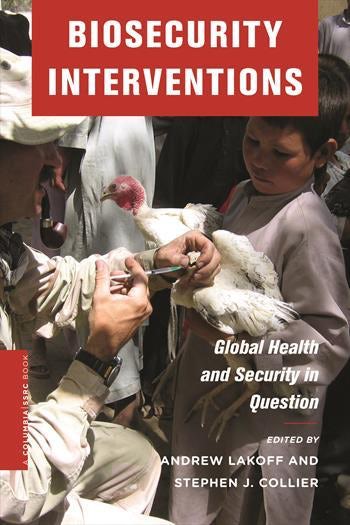
Biosecurity Interventions: Global Health and Security in Question
Edited by Andrew Lakoff and Stephen J. Collier
Columbia University Press, 2008
In recent years, new disease threatssuch as SARS, avian flu, mad cow disease, and drug-resistant strains of malaria and tuberculosishave garnered media attention and galvanized political response. Proposals for new approaches to “securing health” against these threats have come not only from public health and medicine but also from such fields as emergency management, national security, and global humanitarianism.
This volume provides a map of this complex and rapidly transforming terrain. The editors focus on how experts, public officials, and health practitioners work to define what it means to “secure health” through concrete practices such as global humanitarian logistics, pandemic preparedness measures, vaccination campaigns, and attempts to regulate potentially dangerous new biotechnologies.
As the contributions show, despite impressive activity in these areas, the field of “biosecurity interventions” remains unstable. Many basic questions are only beginning to be addressed: Who decides what counts as a biosecurity problem? Who is responsible for taking action, and how is the efficacy of a given intervention to be evaluated? It is crucial to address such questions today, when responses to new problems of health and security are still taking shape. In this context, this volume offers a form of critical and reflexive knowledge that examines how technical efforts to increase biosecurity relate to the political and ethical challenges of living with risk.
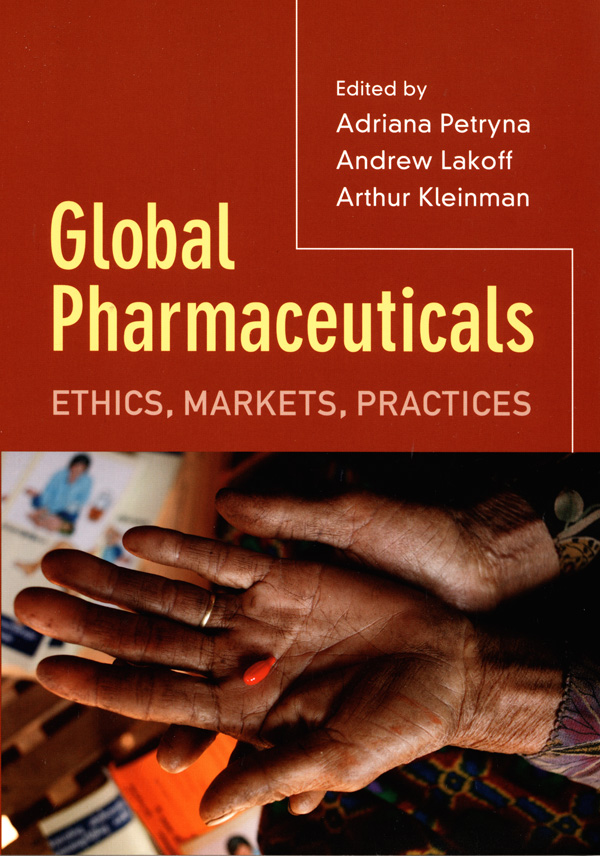
Global Pharmaceuticals: Ethics, Markets, and Practices
Edited by Adriana Petryna, Andrew Lakoff, and Arthur Kleinman
Duke University Press, 2006
In some parts of the world spending on pharmaceuticals is astronomical. In others people do not have access to basic or life-saving drugs. Individuals struggle to afford medications; whole populations are neglected, considered too poor to constitute profitable markets for the development and distribution of necessary drugs. The ethnographies brought together in this timely collection analyze both the dynamics of the burgeoning international pharmaceutical trade and the global inequalities that emerge from and are reinforced by market-driven medicine. They demonstrate that questions about who will be treated and who will not filter through every phase of pharmaceutical production, from preclinical research to human testing, marketing, distribution, prescription, and consumption.
Whether considering how American drug companies seek to create a market for antidepressants in Japan, how Brazil has created a model HIV/AIDS prevention and treatment program, or how the urban poor in Delhi understand and access healthcare, these essays illuminate the roles of corporations, governments, NGOs, and individuals in relation to global pharmaceuticals. Some essays show how individual and communal identities are affected by the marketing and availability of medications. Among these are an exploration of how the pharmaceutical industry shapes popular and expert understandings of mental illness in North America and Great Britain. There is also an examination of the agonizing choices facing Ugandan families trying to finance AIDS treatment. Several essays explore the inner workings of the emerging international pharmaceutical regime. One looks at the expanding quest for clinical research subjects; another at the entwining of science and business interests in the Argentine market for psychotropic medications. By bringing the moral calculations involved in the production and distribution of pharmaceuticals into stark relief, this collection charts urgent new territory for social scientific research.

